G-ME0T9E21S2

Federal Statutes and Directives

This page serves as a centralized reference for federal statutes, laws, and official directives that govern or affect State Defense Forces. It provides lawmakers, government officials, and military departments with authoritative source documents that define federal authorities, limitations, and relationships at the state level. The materials presented here are intended to support informed policy development, legislative review, and institutional understanding of State Defense Forces within the federal framework.

Federal Documents

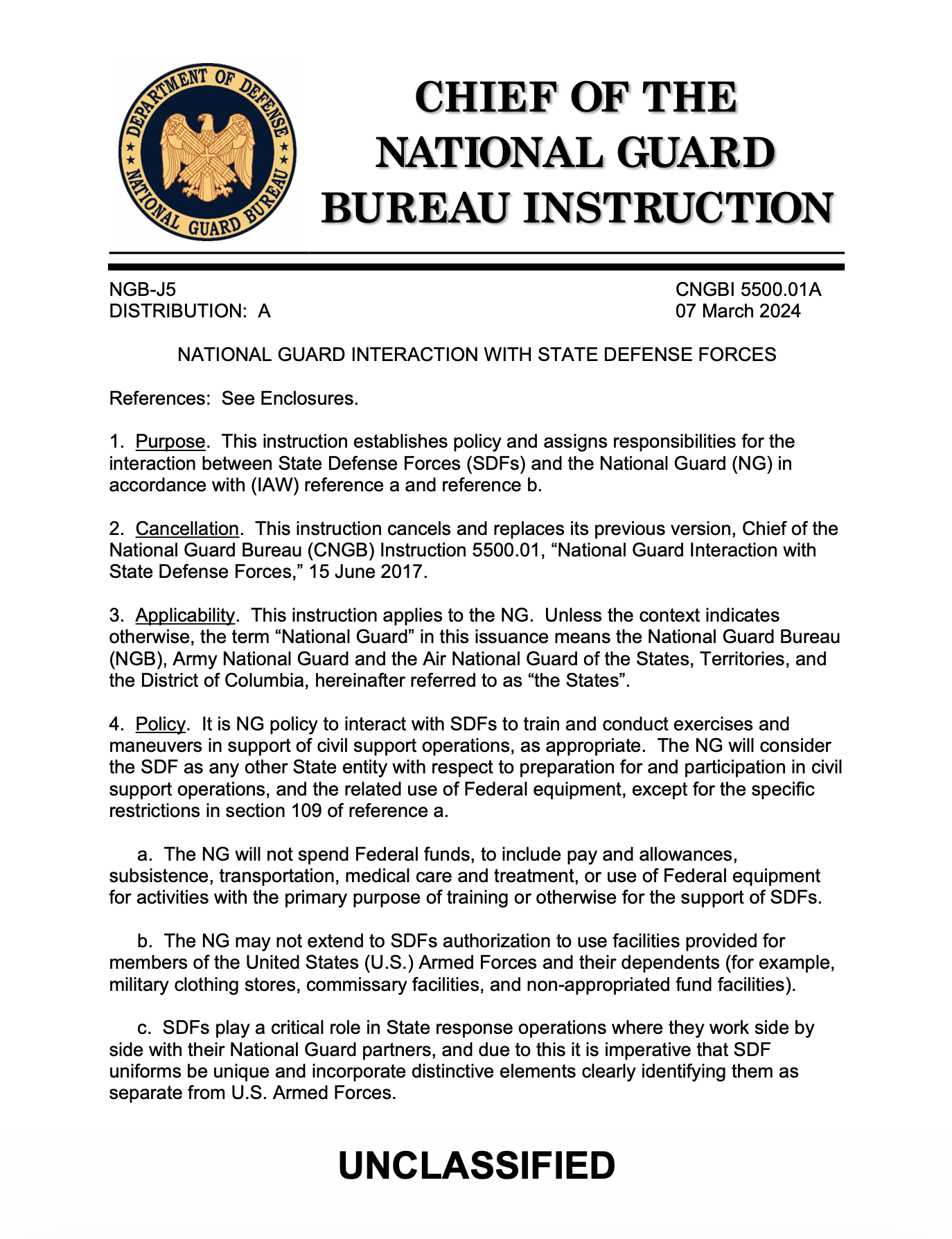
CNGBI 5500.01, National Guard Interaction with State Defense Forces (2024 Revision Update)

The 2024 revision of CNGBI 5500.01 introduced a substantial and dramatic change in uniform guidance for State Defense Forces nationwide. Whereas the 2017 policy principally required State Defense Forces using modified Army uniforms to alter their insignia sufficiently to distinguish themselves from the U.S. Armed Forces such as having their NameTape state the name of The State Defense Force instead of US Army and switch from wearing The US Flag on their right shoulder of their uniform to a State Flag, CNGBI 5500.01A introduced a radical and highly controversial uniform requirement, whereby State Defense Force troops would be required to wear Bright Red or Similar Distinctive Colors to contract their name and State name tapes. The policy also instructed State Defense Force troops no longer wear US Military Patrol Caps, instead transitioning to Bright Red or similar color Baseball caps. The policy instruction didnt end there it also recommended State Defense Forces Rank Insignia be represented in Bright Red and White color, and lastly recommended SDF troops to wear a large bright Red and White Patch on their Uniform stating 'SDF'.

Also the new revised policy advised all State Militaries to no longer allow former US Military Veterans, who were currently serving in The State Defense Force, to wear the awards, Combat Patch and other achievements they earned while serving in The US Military.

Lastly the policy update suggested State Defense Forces convert from a Military Uniform, a uniform they had worn since 1917 to today, to a Polo and Khakis Uniform.

The drastic policy revision was issued during the tenure of General Daniel R. Hokanson as Chief of the National Guard Bureau. Hokanson, who had previously served as The Adjutant General of Oregon from 2013 to 2015, a period during which he dismantled The Oregon State Defense Force by  personally testifying before the Oregon Legislature which led to the disbandment of The ORSDF disbanded.

The 2024 national uniform requirements have subsequently generated widespread concern within the State Defense Force community that forcing these critical State military forces away from a conventional military appearance can undermine military identity, esprit de corps, recruiting & retention, and possibly risk the lives of the men and women who serve in The State Defense Force.

Some States have moved toward substantially altered military uniforms or nontraditional combinations such as polo-style shirts and civilian trousers. The policy marks a strategic shift in State Defense Force,  fastly leading to a drastic decline in recruiting and retention.

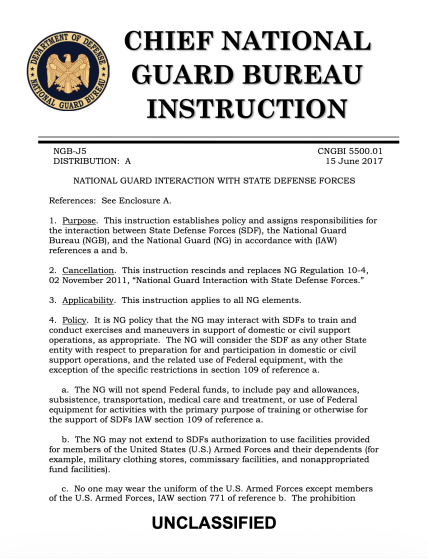
CNGBI 5500.01, National Guard Interaction with State Defense Forces (2017 Revision Update)

The 2017 revised CNGBI 5500.01, National Guard Interaction with State Defense Forces, establishes the National Guard Bureau’s policy governing how the National Guard may interact with State Defense Forces (SDFs). It replaced the earlier 2011 National Guard Regulation 10-4 and formally permits National Guard units to work with SDFs in training, exercises, maneuvers, and domestic or civil-support operations when appropriate. The instruction directs the National Guard to generally treat an SDF like any other State entity participating in domestic-support activities, while maintaining the federal restrictions imposed by law.

The policy also establishes important limits on that relationship. Federal funds, equipment, pay, transportation, medical support, or other federal resources may not be used when the primary purpose is to train or support an SDF. It also restricts SDF access to certain federal military facilities and benefits, establishes requirements for SDF use of modified U.S. military uniforms, limits eligibility for federal awards, and prohibits members of federal reserve components from simultaneously serving in an SDF. The instruction assigns oversight responsibilities to State Adjutants General and several NGB directorates, including provisions for reporting SDF availability, capabilities, and capacity for supporting State civil authorities.
Department of Defense Inspector General Evaluation of State Defense Forces

The Department of Defense Inspector General report DODIG-2014-065 (April 30, 2014) recommended the increased use and creation of State Defense Forces (SDFs) as a cost-effective way to strengthen homeland defense and emergency response. The report noted that restrictive interpretations of federal law (32 U.S.C. § 109) and overly cautious National Guard Bureau policies hindered cooperation, preventing states from fully leveraging SDF capabilities despite their proven value during events like 9/11 and Hurricane Katrina. It urged the Under Secretary of Defense for Policy to clarify what types of coordination with SDFs are legally permissible, and called on the Chief of the National Guard Bureau to revise regulations so that SDFs are treated on par with other state agencies in preparing for and participating in federal responses, including access to federal equipment where allowed. The report concluded that greater reliance on SDFs would enhance national resilience, fill gaps when the National Guard is federally deployed, and provide states with an essential force multiplier for homeland defense needs.

National Guard Policy Regarding Interaction with State Defense Forces

The National Guard Regulation (NGR) 10-4, issued November 2, 2011, sets the official policies and responsibilities for how the National Guard Bureau and state National Guards interact with State Defense Forces (SDFs). It affirms that states are solely responsible for establishing, funding, training, and managing their SDFs under 32 U.S.C. § 109, while clarifying that SDFs may cooperate with the National Guard in domestic operations. However, the regulation restricts the use of federal funds, benefits, and property for SDFs, and prohibits dual membership with federal reserve components. It also establishes rules on uniforms, awards, and access to equipment, ensuring that SDFs remain state-controlled forces that supplement, but are distinct from, federally funded military organizations

Department of Defense House Armed Services Committee Report

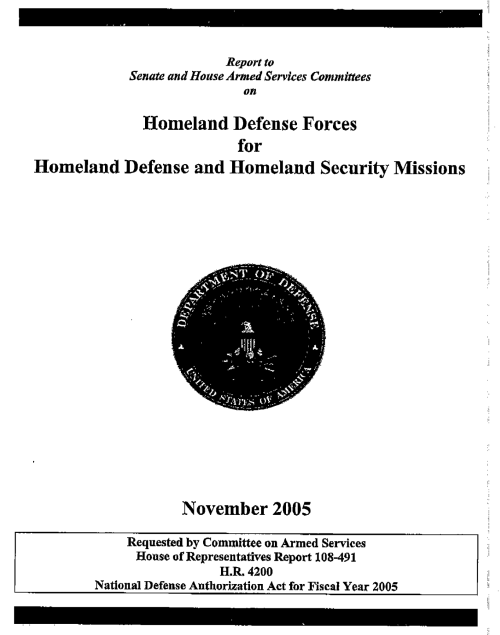
The Department of Defense Report on State Defense Forces (November 2005) was prepared for Congress to assess the role of SDFs in homeland defense and homeland security missions. It recognizes that while states are solely responsible for organizing, training, and funding SDFs, these forces can provide valuable support by augmenting the National Guard during disasters, emergencies, and large-scale incidents. The report suggests that SDFs could help reduce demand on federal forces when the National Guard is deployed, and it notes that DoD may consider providing surplus equipment and training support to governors who choose to employ their SDFs. Overall, it highlights the potential of SDFs as a cost-effective resource for strengthening state and national resilience

Federal Law Authorizing State Defense Forces

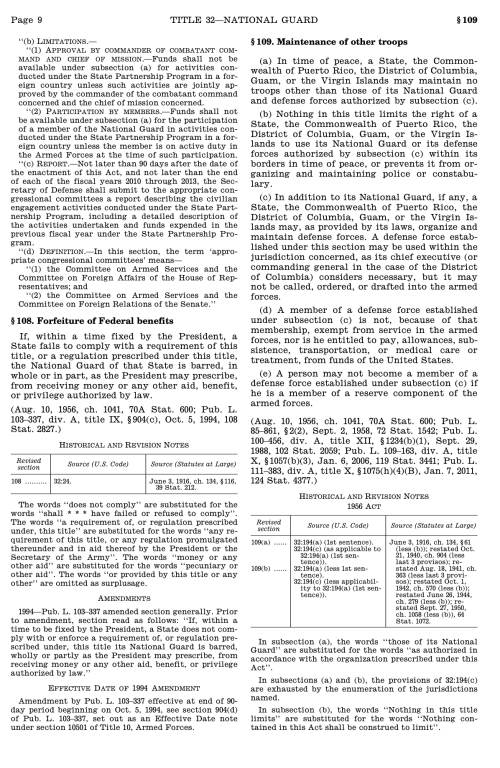
Federal law grants states the authority to organize and maintain State Defense Forces. Under 32 U.S.C. § 109, states and territories may establish these military organizations in addition to their National Guard. These forces operate solely under the authority of the Governor, cannot be called into federal service, and are separate from the U.S. Armed Forces. Federal law also prohibits individuals from serving simultaneously in a federal reserve component and a State Defense Force, and it clarifies that service in a State Defense Force does not entitle members to federal pay, allowances, or benefits.

President Dwight D. Eisenhower 1955 letter to Congress concerning State Defense Forces

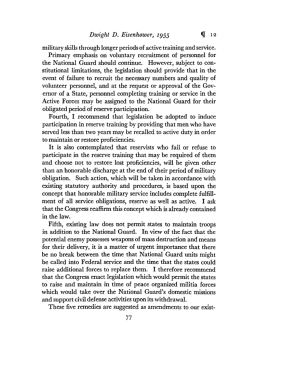
President Dwight D. Eisenhower’s 1955 special message argued that U.S. national security demands armed forces maintained in a state of readiness, backed by a trained reserve pool. He urged Congress to enact legislation strengthening the State Defense Forces, emphasizing that active forces alone were insufficient to meet the threat of sudden global conflict. He also contended that states should be able to maintain troops in addition to the National Guard to prevent any gap in defense when Guard units are federalized, thereby ensuring continuity of homeland security and defense obligations.

State Guard Administration

A Department of The State Guard & Defense Force Council

© Copyright 2026 State Guard Administration - The State Guard & Defense Force Council - All Rights Reserved